Showing posts with label thorium. Show all posts

Sunday, December 12, 2010

Nuclear Technology Basics: Part 2 Thorium Fuel Cycles

Introduction

Part 1


Although most nuclear reactors in the world today use fuel cycles based on the element uranium, it is also possible to use thorium as a source of nuclear energy with some types of nuclear reactors. A thorium-based fuel cycle has several advantages over one that is based on uranium, making it an increasingly attractive option to invest in from an energy production standpoint.


Thorium is element 90 in the periodic table. Like uranium, thorium is a naturally occurring actinide metal that is slightly radioactive when found in nature. Although as many as 33 different isotopes of thorium are possible, the thorium that is found in nature is mostly thorium-232. Thorium ores can be found in abundance all across the world, particularly in India and the western steppes of the US. Since there is currently little use for thorium from a commercial standpoint, there has been little effort to exploit these resources.


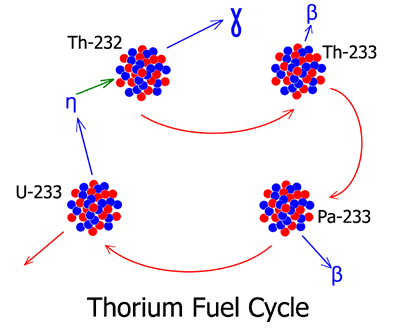
By itself, thorium-232 is not fissile, but if a neutron source is provided such as uranium-235, it can "jumpstart" thorium-232 into a fission chain reaction by causing it to absorb a neutron and become thorium-233. Thorium-233 has a half-life of twenty two minutes at the end of which it emits an electron, causing it to decay into proactinum-233. After 27 days, proactinum releases a second electron and becomes uranium-233.

232Th (n,γ) 233Th (β−) 233Pa (β−) 233U (n,2n)

Uranium-233 has a higher neutron yield than Uranium-235 when it undergoes fission, and therefore releases more energy per neutron absorbed. The decay of Uranium-233 would lead to the creation of numerous isotopes that would be useful from a medical and industrial standpoint and would be able to breed more uranium-233 within the reactor from the neutron irradiation of thorium-232. From a weapons-proliferation standpoint, the thorium-fuel cycle would be very difficult to divert into making fissile warheads. This is because proactinium can also decay into Uranium-232 which emits hard gamma radiation which is a hazard to people who would tamper with the reactor material in addition to the fact that although it is fissile within a reactor, it interferes with fast fission reactions like those within a thermonuclear bomb.

232Th (n,γ) 233Th (β−) 233Pa (n,2n) 232Pa (β−) 232U

Thorium-based fuel cycles have much in the way of economic potential and could be utilized by using off-the-shelf technology. The US experimented with thorium-based reactors during the molten-salt reactor experiment at the Oak Ridge National Laboratory during the mid-1960s until the project was abandoned in favor of uranium-based light water reactors for political reasons. Russia, China, and India are currently looking into the viability of thorium for nuclear energy production, and India is currently using thorium in its pressurized heavy water reactors (PHWRs) and its liquid metal fast breeder reactors (LMFBRs). Ideally, the full potential of thorium could be utilized in a liquid fluoride thorium reactor (LFTR) but it remains to be seen if the LFTR concept gains enough political momentum to allow it to be commerically realized.

Sunday, December 5, 2010

Nuclear Technology Basics Part 1: Uranium Fuel Cycles

Introduction

Most reactors in the world today utilize the uranium fuel cycle to sustain fission, but there are other fuel cycles as well such as ones based on thorium and plutonium. Light water reactors (LWRs) typically have a once-through fuel cycle in which results in various degrees of spent fuel to be disposed of. Breeder reactors and various reprocessing centers can greatly reduce the quantity and half-life of material to be discarded, but nuclear reprocessing is banned in some countries because of errant political concerns rather than for any technical reason such as is seen in the US.

Uranium is a common element that is found in many locations across the world, usually in the form of Uranium oxide. Uranium oxide is a yellowish-brown powder, and is often referred to as "yellowcake". Large deposits of uranium are found in Australia, Africa, Canada, Spain, Russia, and the US where it is mined and sent to an ore processing center. Uranium mines may be either open pit mines when the uranium is close to the surface, or in underground mining tunnels for deeply-buried deposits. Most uranium in the US and Australia is mined using in-situ leeching methods where the uranium oxide is dissolved from the surrounding rock in solution using water that is acidified by carbon dioxide. A LWR reactor requires around .2 metric tonnes of uranium oxide per megawatt produced for its continual operation.

The uranium isotope, U-235 is the primary isotope of interest for power generation. In chemistry and nuclear physics, an isotope of an element is an atom that has a different number of neutrons from the typical number of an atom from that type of element. Uranium has 33 different isotopes, and all of them are radioactive with varying degrees of radioactivity and half-lives. Only .7% of the atoms in naturally occurring uranium oxide are U-235 on average, while the most abundant isotope of uranium is U-238 which accounts for 99.28% of uranium atoms found in nature. Rarer still is the naturally occurring isotope of Uranium U-234 which is slightly more than half a percent of uranium found in deposits on Earth.

In order for mined uranium oxide to be viable for usage in a LWR it must be brought to a fuel fabrication facility where uranium oxide is converted into uranium hexafluoride where the percentage of U-235 is concentrated up to three percent. This is done either through the gaseous diffusion process or the centrifuge process. In either case, "tailings" are produced as a by-product of the process. Uranium "tailings" are largely devoid of the U-235 isotope and consist mostly of U-238. This "depleted" uranium is only weakly radioactive and has many commercial uses because of Uranium's density, ranging from aircraft counter-weights, radiation shielding, boat keels, and munitions. Although uranium itself has a toxicity comparable to lead from a chemological standpoint, uranium is not easily absorbed by living organisms if ingested. The greatest danger comes from the accidental inhalation of the material if it is finely ground into a powder, because the particles can become lodged in the lungs so respiratory protection should be worn when working with powdered uranium compounds. However this is true for many fine particulate substances and is not necessarily unique to uranium. The fears of "depleted uranium" are largely unfounded and baseless.

When the uranium hexafluoride has been enriched to the desired level, it is converted into uranium dioxide which is a fine powder. The uranium dioxide is mechanically pressed into small pellets for use as fuel within a nuclear reactor fuel assembly. The pellets are stacked within tubes made from a metallic alloy of zirconium and serve as fuel rods in the nuclear reactor vessel.

Within the reactor vessel, the Uranium-235 isotope undergoes nuclear fission. Uranium-235 captures and absorbs a stray neutron to become the unstable isotope, Uranium-236. U-236 commonly decays into isotopes of barium, tellurium, krypton, and zirconium and releases energy and two or three neutrons in the process.


These stray neutrons impact other nearby atoms, causing the process to be repeated. In addition, the decay of the daughter products of uranium can create isotopes of other elements as well. Three of the more common decay chains of Uranium U-235 are represented by these equations:

U-235 + n ===> Ba-144 + Kr-90 + 2n + energy

U-235 + n ===> Ba-141 + Kr-92 + 3n + 170 MeV

U-235 + n ===> Zr-94 + Te-139 + 3n + 197 MeV

Interestingly enough, the atomic masses of the isotopes created from the decay of uranium-236 are usually around the low 90s to the mid to upper 130s because of the law of Conservation of Mass in regards to matter. The total mass of the isotopes resulting from the decay of uranium-236 and the neutrons that are released equals a mass of 236, just like the uranium-236 that they decayed from.

After a year or so, 33% of the fuel rods within a nuclear reactor are removed and the reactor is refueled with new fuel to keep the fission reaction going. The spent fuel rods are submerged in a pool of water within the power plant so that they can cool down long enough for further processing and for some of the more radioactive, shorter-lived isotopes to decay. After a few years, the assemblies containing the spent fuel are taken out to be disposed of.

The fission products that were created during the nuclear fission process can be divided into short, intermediate, and long-lived half-life categories.The half-life of an element is the average amount of time for the atoms within a sample of material to have undergone radioactive decay into another element. Most of the fission products have short half-lives that are less than a year. Although many of these isotopes are highly radioactive, they undergo decay during their period in the spent fuel pool and do not present a problem from waste disposal standpoint. Isotopes with an intermediate half-life can be somewhat problematic as they can range anywhere from a year to a century or two and can emit moderately high levels of radiation such as with the case of strontium-90 and cesium-137. These elements can be transmuted into less dangerous isotopes through further neutron bombardment but it is much more cost effective to simply dilute them with inert compounds to the point to where their radioactivity no longer poses a problem. Isotopes with half-lives lasting longer than three centuries can make up to 20% of the spent fuel to be disposed of, but one must keep in mind the inverse relationship between half-life and radioactivity.

Although the half-life of some of these fission by-products can be up to several billion years, they are only weakly radioactive to the point of being barely above the background levels of radiation that all of us are exposed to in our daily lives. As a case in point, potassium-40 has a half-life of 1.3 billion years, and it can set off alarms from radiation detection equipment. However, it is quite abundant in foods with large amounts of potassium in them, such as bananas and it is also found in our bones. However, it is very weakly radioactive as a person only gets an exposure of a few picocuries per year. Eating one banana a day for each day in a year would increase your exposure to radiation by 3.6 milirems per year and the average person receives several hundred milirems per year from naturally occurring background sources with no ill-effects.

Exposure to Radon Per Year By County (Red means high levels of radon)


New Cases of Cancer Diagnosed Per Year By County (High rates are purple)


In countries such as France that use nuclear reprocessing the useful isotopes are separated from the spent fuel assemblies. Since over 90% isotopes within a spent fuel assembly consist of un-fissioned uranium-235, and fissionable plutonium-239 this greatly reduces the volume of the material to be disposed of. The material from a spent fuel assembly can be reduced through reprocessing to a piece of material the size of a cigarette lighter with a half-life of three centuries. The fuel created from this process is known as mixed-oxide fuel, or "MOX" fuel. There are many different types of fuel reprocessing. The most common type is the PUREX method, although research is being conducted into "pyroprocessing" techniques.

Unfortunately, it is often politics that drive policy not common sense and the US is no exception. Although the once-through spent fuel disposal method is wasteful from the standpoint of throwing away a source of useful nuclear fuel, there is not much of it at all. There are three categories of "nuclear waste"; low-level waste, intermediate waste, and high-level waste.

Low-level waste consists of anything from pens and pencils from the offices within a nuclear power plant to the gloves and protective gear worn by personnel. Low-level waste from a nuclear power plant is often very weakly radioactive if it is radioactive at all, and is typically burned or buried close to the surface of a special landfill. Intermediate waste includes things like the actual components of the reactor itself in addition to the materials used in the construction of a nuclear reactor. There is usually not much in the way of intermediate waste to be disposed of and it is often buried in a shallow repository. High-level waste consists of the spent fuel that is marked for disposal.

This material is a metallic solid that has been encased in glass, lined with concrete, and sealed into an extremely durable cask. Tests have demonstrated the ability of these casks to withstand impacts with freight trains. Doomsday scenarios featuring terrorists stealing spent fuel material in order to construct bombs leave out the fact that the concentration of Uranium-235 needs to be enriched up to at least 90% for it to be weapons-grade material. Spent fuel does contain plutonium-239 which can be used for a plutonium bomb, but it is also contaminated with plutonium-240 which is a poison for a nuclear bomb as it absorbs neutrons without fissioning, effectively stealing the neutrons that would be able to strike plutonium-239 that would cause the rapid fission reaction. Fission would occur, but not in the rapid fashion that you would need it to for a nuclear bomb. To make things worse for a terrorist, it would be very difficult to separate the plutonium-239 from the plutonium-240 and it would require highly specialized equipment. It would simply be cheaper and easier to build a special reactor dedicated to producing weapons-grade material like most nations do.

Finally, the amount of high level waste to be disposed of is quite small. All of the high-level waste ever produced in the US as a by-product of nuclear energy could easily fit into a room the size of a high school gymnasium, just two stories high. Compare this to the mountains of coal ash and carbon dioxide generated by the burning of fossil fuels which will be just as toxic millions of years from now as it was the day that it was created.

In part two, we will be taking a look at thorium-based fuel cycles and how nuclear reprocessing works in detail. I hope that this post was easy to read and understand and that it was not too long or boring. Stay tuned!

Tuesday, November 23, 2010

All Fission Reactors Are Not Created Equal

For the next few days or so, I will be taking a look at the different types of nuclear reactors that have existed or have only been theorized about on paper. The reason being is that there are so many different potential reactor designs that it is often confusing to people outside of the field of nuclear engineering to determine how reactor designs differ and what the pros and cons of each design are. To make matters worse, the names of these reactors are often abbreviated to different acronyms making it even more difficult for laypeople to understand what the different terms mean.

This will be a bit of an undertaking, as there are literally hundreds of different reactor designs. Some have only existed on paper, others were only experimental prototypes, while others have been built but have since been decommissioned, either from age, lack of economic viability, or from politics. Although some reactor types are highly impractical or dangerous and have rightfully been consigned to the dustbin of history, there are some designs that would have been quite impressive from an economic and commercial standpoint.

At the moment, I am wondering how to proceed in terms of how I will talk about this. I am leaning towards a series of posts, with each post concerning a different "family" of reactor types based on what they use as their moderator materials. However, I am open to ideas from anybody who might offer suggestions.

Monday, September 20, 2010

Potential New Markets for Nuclear Energy

Part of the slowly emerging interest in nuclear power has been taking a look at regions of the world that would be especially suited for building new nuclear reactors. Several countries in the Middle East such as Bahrain, Jordan, Kuwait, Oman, Qatar, Saudi Arabia, and the United Arab Emirates have expressed interest in having nuclear energy programs. Iran has also been the focus of much news as of late over concerns that its current goal to expand the role of nuclear energy in its energy infrastructure might be a front for developing nuclear arms. However, the process of creating fissionable material for warheads is quite different than the process of generating electricity and a nuclear weapons program would be difficult to keep hidden.

In any case, the middle east would be well-served to invest in nuclear energy as many countries in the region depend heavily on fossil fuels for electricity generation which has negatively impacted the environmental and human health in the region in addition to complicating its political identity. In addition, many people within this area of the world live in arid conditions making agriculture, animal husbandry, and access to water for human consumption difficult. Part of the interest in nuclear energy in the middle east has been driven by its potential application for desalinization. Thousands of gallons of freshwater could be created daily from seawater using the waste heat from a nuclear facility for the fraction of the cost of other desalinization procedures.

In the British isles, Britain has been seriously considering new nuclear development as many of its existing nuclear facilities are aging as no new nuclear facilities have been built in years. This reflects a similar situation as we have seen in the US. As coal and natural gas have major drawbacks in regards to pollution from carbon dioxide and in the case of coal; ash and soot, the British government has started to re-evaluate the viability of nuclear energy in Britain's energy portfolio. Ireland has traditionally been vehemently against any sort of nuclear development choosing to rely on burning peat, low-grade coal, and imported natural gas. The rapid pace of economic development has lead to considerable demand for more energy in the nation, and Ireland has been mulling over the potential of nuclear energy to alleviate a potential energy shortage. Although anti-nuclear sentiments remain strong in the country, this may change as people become more educated about the inherent safety of nuclear energy as well as its minimal environmental impact. This is especially poignant when considering the amount of pollution that the burning of peat and fossil fuels causes when Ireland has recently become concerned about its environmental health.

Australia remains an important source of uranium yet its traditional stance against nuclear energy has prevented any reactors being built and has chosen to largely use coal for energy instead. The impact of Australia's large coal mines have scarred the landscape. The amount of carbon dioxide and particulate matter produced from Australia's coal plants is immense, especially when one considers that some of it is also very low-grade lignin which is even more polluting than bituminous coal when burned. To make matters worse, various "environmentalist" groups have recently put pressure on Australia's government to limit uranium mining and exploration yet remain strangely silent when it comes to the continual operation of Australia's coal infrastructure. There have been calls in Australia for the development of nuclear energy but it remains to be seen if Australia's defacto ban on nuclear energy will remain for the future as many countries in Europe have either lifted or stalled their moratoriums on nuclear energy.

Finally, Asia has been aggressively expanding its investment in nuclear energy, particularly China, Korea, and India. These countries are poised to be the leaders in new nuclear technological development as the nuclear energy market in the US has stalled. Although there has been renewed interest in building new nuclear reactors in the US, it pales in comparison to the rapid degree of nuclear development in Asia.

Monday, January 25, 2010

Thorium Comic

This is interesting. The Energy From Thorium blog posted a webcomic regarding thorium energy. Take a look

Tuesday, January 19, 2010

Changing Minds, but is it Enough?

When I started this blog two years ago, it was out of a combination of frustration and anger at how quickly people dismissed nuclear energy like it was some sort of arcane and unholy type of technology. Even though the facts were otherwise, many people still opposed it tooth and nail as they either ignored the benefits or thought that the data itself was part of some sort of conspiracy promoted by "Big Nuclear". I was never against nuclear power at all, even when I was relatively misinformed about it but I did have some reservations about what to do with the spent fuel as I like many other people thought that it was dangerous and difficult to deal with. However, I still thought that was magnitudes better when compared to coal and natural gas. As these fuel sources were very dirty indeed and as it was the late 20th, early 21st century I thought that it was ridiculous that we were still depending on fossil fuels as our main source of energy. Yet I also knew that wind and solar power lacked the energy density and reliability to be able to produce the amount of electricity on a regular basis that a developed country like the US needed.

Then my eyes caught an article in Scientific American around 2005 talking about nuclear energy and what sorts of reactors could be built and the pros and cons of the different designs. I was fascinated as I read about designs that could be used to breed more fuel or greatly reduce the quantity and half-life of existing stockpiles of spent fuel as well as close the nuclear fuel cycle to ensure a virtually infinite and environmentally friendly source of energy. I also began to grow very angry, as the only thing holding nuclear technology back seemed to be a combination of NIMBYism, fossil fuel interests, and just the overall lack of will that would be needed to restructure our energy producing infrastructure.

I began to research nuclear power online as a hobby in addition to reading whatever I could find on it in various books and publications. My amazement was underlined by seething anger at how the US had let coal and natural gas expand and entrench themselves over the decades as we had not built a new nuclear reactor in this country since the 1970s. Our back was turned on nuclear power out of a combination of fear, pointless bureaucratic redtape, and the canceling of many planned reactor projects after the oil crisis thirty-seven years ago. This was all due to politics and scaremongering rather than a legitimate reason to condemn nuclear power.

This was a direct reversal of the attitude that characterized the previous two decades as nuclear powerplants were being built at a rapid pace and nuclear reactors were quickly adapted to be used for naval use. The cold war and a feeling of optimism towards nuclear science and technology spurred rapid development in this field and it also threatened to put coal power out of business. However, the nuclear industry was practically moribund by the early eighties through a misinformed but successful campaign against nuclear energy that had grown out of the fear of nuclear warfare and was helped along by fossil fuel lobbyists and their paid off politicians. Ironically, nuclear power has had the best safety record of any energy sector in the US and even across the world yet it had been rejected in favor of coal which kills thousands of people worldwide through its normal operation.

After seeing the ridiculous comments and hysterical fears surrounding nuclear power being touted by various "environmentalists" I decided to create this blog in the hopes of taking an honest look at nuclear power. This was part of an effort to help people realize the environmental benefits of an infrastructure largely based on nuclear energy as well as the fact that nuclear power is the only clean form of energy that can be used practically anywhere on earth and deliver a constant supply of energy regardless of weather conditions. Scaling back production and energy usage would never be the answer because as we increase our technological development, the demand for energy increases. However, it is through more technology, not less that we can hope to make a better world for everyone. The past is gone, but trying to revisit the past by rejecting technological progress would be foolish because the "past" presented by various primitivist and neoluddite groups is based on a highly idealized and impractical vision of what previous generations of humanity really faced. Ironically, the popularity of these movements has been aided by the technology brought to them by the internet and computer revolution. I would very much doubt that humanity would want to go back to the days before running water, electricity, heating, cooling, hygiene, sanitation, and modern medicine. We can thank all of these previous comforts for our greatly improved lifespans. A few hundred years earlier, a middle-aged man or woman of 40 would be considered elderly.

As I look around, I see that people are slowly starting to realize that nuclear energy is not nearly as bad as various sources portray it as being. There is a lot of misinformation and outright lies regarding nuclear technology as there are many organizations that have made it their business to vehemently oppose nuclear power on all fronts, especially when they have or are allied with entrenched fossil fuel interests. I have a cautious degree of optimism as I watch people starting to push back against this tide of nonsense and hope that we can start looking forwards to a clean, energy rich future again as nuclear power is the only option that we have that can deliver on this promise. We need to get the liquid fluoride thorium reactor development path up and running again after its cancellation during the early 1970's as this design shows a stunning degree of versatility and efficiency at practically little to no cost to the environment.

Tuesday, December 22, 2009

Odds and Ends

I have added the informative blog, BraveNewClimate to my blog roll as it has been recommended to posters on the Energy From Thorium forum. The blogger, Barry Brooks does an excellent job in reporting on developments in climate science as well as critically examining the potential feasibility of "green" energy sources such as "renewables". Take a look at his December 17th post on the potential of the LFTR in Australia.

In other news, Florida might be making the shift from coal power to nuclear energy as Seminole Electric canceled its latest plan for a coal power station. As Seminole Electric has also been considering nuclear power as one of its future energy options, this might be a point in favor of nuclear power. Florida is relatively poor in natural gas, and transporting natural gas over long distances is an expensive undertaking.

Monday, December 14, 2009

The Economist on Gen IV nuclear technology

Alright my fellow nukeheads, take a look at this interesting post on different reactor types by the Economist magazine.

"The sixth shortlisted design, the molten salt reactor (MSR), works by dissolving nuclear fuel in a fluoride solution, which acts as both the fuel and the coolant in the reactor core. The molten salt, which has good heat-transfer properties and can be heated to temperatures above 1,000{degree}C without boiling, is moderated using graphite. The circulation of the fuel in this way eliminates the need for fuel fabrication and allows for continuous online reprocessing. It also makes the design well suited to the use of existing fissile material, which can be easily blended into the fuel mixture. And like fast reactors, the MSR can be designed to burn up many of the longer-lived byproducts of the fission process, resulting in nuclear waste that is much less radioactive than that produced by the once-through cycle."

The article is a pretty good introduction to several reactor designs and the technical aspects of each. I recommend it as a primer for those of you who are curious as to where we stand with nuclear research. Happy reading.

Friday, November 27, 2009

India: The Next Leader In Nuclear Technology?

India has been researching the use of nuclear technology at breakneck speed. India is relatively deficient in coal and it has a lot more thorium than uranium. Because of this, India is currently pushing the AEC reactor design, but it could just as easily develop the LFTR paradigm as well.

China is also planning a large build out for new reactors, but the Chinese are also pushing coal as well as there are quite a few large coal deposits in eastern China. The degree of innovation displayed by Indian nuclear researchers is impressive, as well as the fact that it could make India's economy a force to be reckoned with as cheap energy spurs technological development. In addition, India's nuclear program is not hampered with regulations against nuclear reprocessing like in the US. This puts America at a disadvantage once again as we risk being left behind in the dust in our failure to embrace clean nuclear energy.

Interestingly, when you look at many countries that have an abundance of coal such as the US, China, and Australia, they also have ample supplies of uranium and thorium. However, the availability of coal has lead to its promotion in the national policies of the energy agendas of these countries. This is in spite of the fact that coal causes massive amounts of pollution both from carbon dioxide and the contamination from heavy metals. Injuries and deaths from coal are also a common occurrence from everyday operation in the coal industry.

There really is no longer any reason for the continual use of coal as the baseload energy source of choice. We have had the technology to replace coal with nuclear power for decades, and new reactor designs such as the LFTR are even more impressive than traditional light water reactors. At this point, coal is the soot-covered chain that is holding us back from cheap, clean energy in the form of nuclear power.

Monday, July 27, 2009

Replacing Fossil Fuels by Using More Natural Gas?

One thing that I do not understand is why natural gas is being pushed so much by "environmentalists", particularly because natural gas does produce quite a bit of carbon dioxide when burned. Not as much as coal, mind you, but enough to be a major contributor of carbon dioxide pollution. Renewable energy sources such as wind and solar are hardly efficient and are basically a roundabout way of burning natural gas as natural gas burning generators have to take up the slack when the wind is not blowing or the sun is not shining. There are also vehicles that run on liquified natural gas as opposed to gasoline. If we look at the annual estimated end use statistics for natural gas since 1949, you will see that consumption has risen greatly*.

Consumption Graph

Also, looking at this graph, you can see that the annual wellhead price for natural gas has risen sharply to meet demand since the year 2000*.

Price Graph

Natural gas is as much as a fossil fuel as coal and oil yet much of the renewables paradigm is leading to a rapid increase in natural gas consumption both on the atmosphere as well as depletion of consumers wallets. Because of the rapid fluctuations in price that natural gas is subject to, this increasingly expensive fuel energy source is an impractical alternative for running an energy grid. It will also make coal cheaper by comparison and lead to increased usage of coal in the long run as natural gas prices continue to climb at a much faster rate than coal prices.

To make a long story short, natural gas is a fossil fuel and like all fossil fuels has major disadvantages. The renewables movement only increases our reliance on fossil fuels in the form of natural gas and coal while derailing interest and funding from viable sources of energy such as nuclear power. I do not mean to come off as being harsh in regards to solar and wind power, but the only practical application that either of these two energy sources seem to have is for the operation of small appliances or for pumping water.

*As provided by the US Energy Information Administration.

Sunday, July 26, 2009

Could This Be the Beginning of the Thorium Age?

Lots of exiting things have been happening on the horizon for the future of thorium-based energy, particularly in the form of the Liquid Fluoride Thorium Reactor (LFTR) concept. I would like to draw your attention to a recent Tech Talk sponsored by Google. Kirk Sorensen, an expert on the LFTR as well as being a brilliant man gave an informative as well as enlightening speech on potential of the LFTR in regards to the future of energy. It is quite a long video, but I strongly recommend that those of you who are interested in the future of clean energy watch it in its entirety. Not only can the LFTR provide a cheap source of plentiful, environmentally friendly electricity, the waste heat from an LFTR can be used for many applications ranging from an economic means of desalinization to the production of synthetic fertilizers and fuels with no need to use petroleum or natural gas. Hydrogen can be thermochemically produced from water at the operating temperature of an LFTR, and carbon can be extracted from the atmosphere. By doing this, you can synthetically produce alkanes that form the basis of organic chemistry such as the production of polymers and the refining process of petroleum into liquid fuels. By doing this, you could produce synthetic fuels like dimethyl ether or methanol and they would be carbon neutral when burned since the carbon used for their production was originally extracted from the atmosphere.


Next, there have been a whole series of LFTR-related recent posts over at the fascinating blog, The Nuclear Green Revolution run by Charles Barton, a man whom I admire. His father was a researcher over at the Oak Ridge project during the Molten Salt Reactor (MSR) experiments of the 1960's before the MSR project was de-funded for political reasons. He offers a personal insight into both the convoluted history behind MSR-type reactors as well as the political issues that caused the project to be canceled in the first place. Mr. Barton has a series of essays looking at the economic means of lowering the costs of construction and operation of nuclear reactors as well as promoting new nuclear research.

Preface

1. The Keys to Lowering Reactor Costs: Economies of Scale or Serial Production?
2. The Keys to Lowering Reactor Costs: Advanced Materials
3. The Keys to Lowering Reactor Costs: Inherent Safety
4. The Keys to Lowering Reactor Costs: Nuclear Waste
5. The Keys to Lowering Reactor Costs: Labor Costs
5a. Addendum: Estimated US Energy Use in 2008: ~99.2 Quads
6. The Keys to Lowering Reactor Costs: Some Siting Considerations
7. The Keys to Lowering Reactor Costs: Investment Costs
8. The Keys to Lowering Reactor Costs: Research and Development

Confessions of a Nuclear Blogger, Part I

Finally, we have a post by davidwalters over at the Daily Kos comparing the economics of scaling behind the different potential sizes of the LFTR. He also has an interesting analysis of a means of their deployment as well as their potential to be used for naval transportation. An LFTR-powered cargo ship would be orders of magnitudes cleaner than ones that use conventional sources of energy, such as marine diesel which is one of the dirtiest grades of liquid fuel in existence.

Friday, May 15, 2009

Whither the Nuclear Renaissance?

I have heard mixed opinions from the Obama administration in regards to nuclear energy. Energy secretary Steven Chu seems to have a cautiously positive opinion of nuclear power. At the same time it seems the stimulus bill passed in February had the loan guarantees for nuclear construction written out of it while spending billions of dollars on "renewables" even though renewable energy sources by their very nature are both expensive and unreliable. I am left wondering what Obama really plans to do about nuclear power.

He at least acknowledged it during his campaign but when he said in needed to be "safer" it made me think that he was uninformed about how safe nuclear power really is. Very few industries in the world have safety records that could compare to nuclear energy in terms of the lack deaths or injuries in the years since nuclear energy was first developed. The two infamous incidents, Chernobyl and Three Mile Island are frequently referenced by wide-eyed activists but the Chernobyl reactor did not have a containment dome that could have prevented the entire disaster as all new reactors across the world have now. At Three Mile Island, human error and lack of maintenance combined lead to a very serious malfunction, yet the safety systems built into the design of Three Mile Island prevented anybody from being injured or killed by the incident. To drive the point home even further, I have never heard of a single incident of somebody being injured or killed by spent fuel. Yet despite all of this, an embarrassingly large segment of the world population is eager to listen when activists paint the nuclear industry as being a modern day "Frankenstein's monster" poisoning the land and the nearby people with a mysterious force called radiation. Much of the public's imagination (Often fueled by science fiction B movies) has taken to thinking of radiation as being something that causes spontaneous and severe mutations such as animals growing to several hundred times their normal size or sprouting extra limbs. The more "informed" merely think that a nuclear power plant by its very nature will somehow cause the nearby populace to fall ill and be struck down by maladies such as cancer and radiation sickness.

Also, on the face of it, the idea seems rather absurd as to why Steven Chu seems unwilling to consider the MSR designs for Gen IV funding because of proliferation fears. The proliferation risk of an MSR design is quite low because the entire reactor would have to be shut down in order to divert the produced U233 into weapons production. The U233 will be contaminated with U232 and U234 that decay producing hard gamma radiation and terrorists working in a hastily constructed garage or cave would be hard pressed to steal enough for a bomb without instantly dying of radiation poisoning. There is also the question about how a terrorist would manage to steal liquid U233 from the molten core of the MSR which is surrounded by a massive field of radiation especially since you would have to shut down the MSR and reroute the plumbing of the reactor for such an operation. With that being said and done, it would be a lot easier to raid a radiology clinic for nuclear material.

Finally, the appointment of Gregory Jaczko as the new Chairman of the NRC has me concerned. Part of the problem of constructing new nuclear facilities is the inefficient and often nonsensical approval process that a power company must go through in order to obtain an operating license. I have heard some reports that Jaczko is in agreement with some anti-nuclear environmentalists groups and that he voted against renewing the operating license for the Oyster Creek reactor in New Jersey as well as collaborating with Rep. Ed Markey (D) for imposing more stringent regulations on classifying spent fuel when the nuclear industry is already choking on overregulation in general.

This is not to say that previous presidential administrations have been any more open minded in regards to promoting nuclear energy. The Bush administration amidst many of its other problems paid lip service to nuclear power while simply allowing it to languish during its pursuit of fossil fuel energy in the form of coal, oil, and natural gas. In fact, a large part of presidential candidate McCain's energy policy during his campaign was the promotion of "clean coal" of which there is no such thing. Opposition to nuclear power sadly seems to be a bi-partisan phenomenon in the US.

Perhaps I am being overly pessimistic here. I would like to get a discussion going as to what my readers think we might expect in regards to nuclear energy under this administration. Are nuclear energy promotion efforts really being noticed, or are they just a minority in the void of the internet that is too willing to pat itself on the back as coal and natural gas take center stage in the future as they have in the past?

Sunday, January 11, 2009

Impressions of AREVA

I attended the conference call hosted by AREVA on the 9th and it was a very interesting experience. AREVA was looking into setting up a blog of its own detailing its activities and was looking for feedback from members on the Nuclear Advocacy Webring. AREVA's representative allowed us all to ask questions and converse with each other in order to come to a consensus about the direction that it should take as part of its outreach policy.

I was thoroughly impressed with the friendly and open atmosphere during the conference call. All of us shared an interest in the future of nuclear energy and combating the idiotic and silly myths that have surrounded this valuable energy source. AREVA hopes to schedule more meetings like this in the future based on the success of this one.

Finally, I offer my thanks to the nuclear advocacy webring for being so supportive to all of its members. It is important that we work together to help combat the anti-nuclear hysteria that is so prevalent in some parts of the developed world. If we ever hope to take the challenge of helping the environment seriously, then nuclear power is the way forward.

Sunday, October 5, 2008

Hope for Thorium Based Power?

Senators Harry Reid and Orrin Hatch introduced the Thorium Energy Independence and Security Act of 2008 on the 2nd of October.

http://newsblaze.com/story/2008100213330200003.pnw/topstory.html

This would clear some of the hurdles in place with the DOE and the NRC that would prevent advanced fission reactors like the LFTR from being built in the US. It would also mean that the thousands of tons worth of surplus thorium that the US has buried in the southwest would finally have a use. Other than the surplus, the US has a very high concentration of minerals that could be mined for thorium ore in Lehmi Pass, Idaho.

If this bill passes, and I hope it does, it would mean that America's energy policy would have some direction after all. Wind and solar power are not going to cut it, and coal has long overstayed its welcome. As an added bonus, the fission byproducts that result from a thorium fission reacton are practically useless for making nuclear warheads out of.