Showing posts with label political problems. Show all posts

Sunday, December 5, 2010

Nuclear Technology Basics Part 1: Uranium Fuel Cycles

Introduction

Most reactors in the world today utilize the uranium fuel cycle to sustain fission, but there are other fuel cycles as well such as ones based on thorium and plutonium. Light water reactors (LWRs) typically have a once-through fuel cycle in which results in various degrees of spent fuel to be disposed of. Breeder reactors and various reprocessing centers can greatly reduce the quantity and half-life of material to be discarded, but nuclear reprocessing is banned in some countries because of errant political concerns rather than for any technical reason such as is seen in the US.

Uranium is a common element that is found in many locations across the world, usually in the form of Uranium oxide. Uranium oxide is a yellowish-brown powder, and is often referred to as "yellowcake". Large deposits of uranium are found in Australia, Africa, Canada, Spain, Russia, and the US where it is mined and sent to an ore processing center. Uranium mines may be either open pit mines when the uranium is close to the surface, or in underground mining tunnels for deeply-buried deposits. Most uranium in the US and Australia is mined using in-situ leeching methods where the uranium oxide is dissolved from the surrounding rock in solution using water that is acidified by carbon dioxide. A LWR reactor requires around .2 metric tonnes of uranium oxide per megawatt produced for its continual operation.

The uranium isotope, U-235 is the primary isotope of interest for power generation. In chemistry and nuclear physics, an isotope of an element is an atom that has a different number of neutrons from the typical number of an atom from that type of element. Uranium has 33 different isotopes, and all of them are radioactive with varying degrees of radioactivity and half-lives. Only .7% of the atoms in naturally occurring uranium oxide are U-235 on average, while the most abundant isotope of uranium is U-238 which accounts for 99.28% of uranium atoms found in nature. Rarer still is the naturally occurring isotope of Uranium U-234 which is slightly more than half a percent of uranium found in deposits on Earth.

In order for mined uranium oxide to be viable for usage in a LWR it must be brought to a fuel fabrication facility where uranium oxide is converted into uranium hexafluoride where the percentage of U-235 is concentrated up to three percent. This is done either through the gaseous diffusion process or the centrifuge process. In either case, "tailings" are produced as a by-product of the process. Uranium "tailings" are largely devoid of the U-235 isotope and consist mostly of U-238. This "depleted" uranium is only weakly radioactive and has many commercial uses because of Uranium's density, ranging from aircraft counter-weights, radiation shielding, boat keels, and munitions. Although uranium itself has a toxicity comparable to lead from a chemological standpoint, uranium is not easily absorbed by living organisms if ingested. The greatest danger comes from the accidental inhalation of the material if it is finely ground into a powder, because the particles can become lodged in the lungs so respiratory protection should be worn when working with powdered uranium compounds. However this is true for many fine particulate substances and is not necessarily unique to uranium. The fears of "depleted uranium" are largely unfounded and baseless.

When the uranium hexafluoride has been enriched to the desired level, it is converted into uranium dioxide which is a fine powder. The uranium dioxide is mechanically pressed into small pellets for use as fuel within a nuclear reactor fuel assembly. The pellets are stacked within tubes made from a metallic alloy of zirconium and serve as fuel rods in the nuclear reactor vessel.

Within the reactor vessel, the Uranium-235 isotope undergoes nuclear fission. Uranium-235 captures and absorbs a stray neutron to become the unstable isotope, Uranium-236. U-236 commonly decays into isotopes of barium, tellurium, krypton, and zirconium and releases energy and two or three neutrons in the process.


These stray neutrons impact other nearby atoms, causing the process to be repeated. In addition, the decay of the daughter products of uranium can create isotopes of other elements as well. Three of the more common decay chains of Uranium U-235 are represented by these equations:

U-235 + n ===> Ba-144 + Kr-90 + 2n + energy

U-235 + n ===> Ba-141 + Kr-92 + 3n + 170 MeV

U-235 + n ===> Zr-94 + Te-139 + 3n + 197 MeV

Interestingly enough, the atomic masses of the isotopes created from the decay of uranium-236 are usually around the low 90s to the mid to upper 130s because of the law of Conservation of Mass in regards to matter. The total mass of the isotopes resulting from the decay of uranium-236 and the neutrons that are released equals a mass of 236, just like the uranium-236 that they decayed from.

After a year or so, 33% of the fuel rods within a nuclear reactor are removed and the reactor is refueled with new fuel to keep the fission reaction going. The spent fuel rods are submerged in a pool of water within the power plant so that they can cool down long enough for further processing and for some of the more radioactive, shorter-lived isotopes to decay. After a few years, the assemblies containing the spent fuel are taken out to be disposed of.

The fission products that were created during the nuclear fission process can be divided into short, intermediate, and long-lived half-life categories.The half-life of an element is the average amount of time for the atoms within a sample of material to have undergone radioactive decay into another element. Most of the fission products have short half-lives that are less than a year. Although many of these isotopes are highly radioactive, they undergo decay during their period in the spent fuel pool and do not present a problem from waste disposal standpoint. Isotopes with an intermediate half-life can be somewhat problematic as they can range anywhere from a year to a century or two and can emit moderately high levels of radiation such as with the case of strontium-90 and cesium-137. These elements can be transmuted into less dangerous isotopes through further neutron bombardment but it is much more cost effective to simply dilute them with inert compounds to the point to where their radioactivity no longer poses a problem. Isotopes with half-lives lasting longer than three centuries can make up to 20% of the spent fuel to be disposed of, but one must keep in mind the inverse relationship between half-life and radioactivity.

Although the half-life of some of these fission by-products can be up to several billion years, they are only weakly radioactive to the point of being barely above the background levels of radiation that all of us are exposed to in our daily lives. As a case in point, potassium-40 has a half-life of 1.3 billion years, and it can set off alarms from radiation detection equipment. However, it is quite abundant in foods with large amounts of potassium in them, such as bananas and it is also found in our bones. However, it is very weakly radioactive as a person only gets an exposure of a few picocuries per year. Eating one banana a day for each day in a year would increase your exposure to radiation by 3.6 milirems per year and the average person receives several hundred milirems per year from naturally occurring background sources with no ill-effects.

Exposure to Radon Per Year By County (Red means high levels of radon)


New Cases of Cancer Diagnosed Per Year By County (High rates are purple)


In countries such as France that use nuclear reprocessing the useful isotopes are separated from the spent fuel assemblies. Since over 90% isotopes within a spent fuel assembly consist of un-fissioned uranium-235, and fissionable plutonium-239 this greatly reduces the volume of the material to be disposed of. The material from a spent fuel assembly can be reduced through reprocessing to a piece of material the size of a cigarette lighter with a half-life of three centuries. The fuel created from this process is known as mixed-oxide fuel, or "MOX" fuel. There are many different types of fuel reprocessing. The most common type is the PUREX method, although research is being conducted into "pyroprocessing" techniques.

Unfortunately, it is often politics that drive policy not common sense and the US is no exception. Although the once-through spent fuel disposal method is wasteful from the standpoint of throwing away a source of useful nuclear fuel, there is not much of it at all. There are three categories of "nuclear waste"; low-level waste, intermediate waste, and high-level waste.

Low-level waste consists of anything from pens and pencils from the offices within a nuclear power plant to the gloves and protective gear worn by personnel. Low-level waste from a nuclear power plant is often very weakly radioactive if it is radioactive at all, and is typically burned or buried close to the surface of a special landfill. Intermediate waste includes things like the actual components of the reactor itself in addition to the materials used in the construction of a nuclear reactor. There is usually not much in the way of intermediate waste to be disposed of and it is often buried in a shallow repository. High-level waste consists of the spent fuel that is marked for disposal.

This material is a metallic solid that has been encased in glass, lined with concrete, and sealed into an extremely durable cask. Tests have demonstrated the ability of these casks to withstand impacts with freight trains. Doomsday scenarios featuring terrorists stealing spent fuel material in order to construct bombs leave out the fact that the concentration of Uranium-235 needs to be enriched up to at least 90% for it to be weapons-grade material. Spent fuel does contain plutonium-239 which can be used for a plutonium bomb, but it is also contaminated with plutonium-240 which is a poison for a nuclear bomb as it absorbs neutrons without fissioning, effectively stealing the neutrons that would be able to strike plutonium-239 that would cause the rapid fission reaction. Fission would occur, but not in the rapid fashion that you would need it to for a nuclear bomb. To make things worse for a terrorist, it would be very difficult to separate the plutonium-239 from the plutonium-240 and it would require highly specialized equipment. It would simply be cheaper and easier to build a special reactor dedicated to producing weapons-grade material like most nations do.

Finally, the amount of high level waste to be disposed of is quite small. All of the high-level waste ever produced in the US as a by-product of nuclear energy could easily fit into a room the size of a high school gymnasium, just two stories high. Compare this to the mountains of coal ash and carbon dioxide generated by the burning of fossil fuels which will be just as toxic millions of years from now as it was the day that it was created.

In part two, we will be taking a look at thorium-based fuel cycles and how nuclear reprocessing works in detail. I hope that this post was easy to read and understand and that it was not too long or boring. Stay tuned!

Monday, November 22, 2010

Nuclear Energy in Asia is Going Full Steam Ahead

India has started construction of a new nuclear facility in Gujarat. It will be a pair pressurized heavy water reactors (PHWRs) that will generate 700 megawatts each. Planning started in January of this year after the site for the reactor was excavated within a short time frame of four months. Construction began today, and the reactor is expected to be online by 2015.

If India can do this, then why should it be so difficult to build new reactors in Europe and the US?

Monday, September 20, 2010

Potential New Markets for Nuclear Energy

Part of the slowly emerging interest in nuclear power has been taking a look at regions of the world that would be especially suited for building new nuclear reactors. Several countries in the Middle East such as Bahrain, Jordan, Kuwait, Oman, Qatar, Saudi Arabia, and the United Arab Emirates have expressed interest in having nuclear energy programs. Iran has also been the focus of much news as of late over concerns that its current goal to expand the role of nuclear energy in its energy infrastructure might be a front for developing nuclear arms. However, the process of creating fissionable material for warheads is quite different than the process of generating electricity and a nuclear weapons program would be difficult to keep hidden.

In any case, the middle east would be well-served to invest in nuclear energy as many countries in the region depend heavily on fossil fuels for electricity generation which has negatively impacted the environmental and human health in the region in addition to complicating its political identity. In addition, many people within this area of the world live in arid conditions making agriculture, animal husbandry, and access to water for human consumption difficult. Part of the interest in nuclear energy in the middle east has been driven by its potential application for desalinization. Thousands of gallons of freshwater could be created daily from seawater using the waste heat from a nuclear facility for the fraction of the cost of other desalinization procedures.

In the British isles, Britain has been seriously considering new nuclear development as many of its existing nuclear facilities are aging as no new nuclear facilities have been built in years. This reflects a similar situation as we have seen in the US. As coal and natural gas have major drawbacks in regards to pollution from carbon dioxide and in the case of coal; ash and soot, the British government has started to re-evaluate the viability of nuclear energy in Britain's energy portfolio. Ireland has traditionally been vehemently against any sort of nuclear development choosing to rely on burning peat, low-grade coal, and imported natural gas. The rapid pace of economic development has lead to considerable demand for more energy in the nation, and Ireland has been mulling over the potential of nuclear energy to alleviate a potential energy shortage. Although anti-nuclear sentiments remain strong in the country, this may change as people become more educated about the inherent safety of nuclear energy as well as its minimal environmental impact. This is especially poignant when considering the amount of pollution that the burning of peat and fossil fuels causes when Ireland has recently become concerned about its environmental health.

Australia remains an important source of uranium yet its traditional stance against nuclear energy has prevented any reactors being built and has chosen to largely use coal for energy instead. The impact of Australia's large coal mines have scarred the landscape. The amount of carbon dioxide and particulate matter produced from Australia's coal plants is immense, especially when one considers that some of it is also very low-grade lignin which is even more polluting than bituminous coal when burned. To make matters worse, various "environmentalist" groups have recently put pressure on Australia's government to limit uranium mining and exploration yet remain strangely silent when it comes to the continual operation of Australia's coal infrastructure. There have been calls in Australia for the development of nuclear energy but it remains to be seen if Australia's defacto ban on nuclear energy will remain for the future as many countries in Europe have either lifted or stalled their moratoriums on nuclear energy.

Finally, Asia has been aggressively expanding its investment in nuclear energy, particularly China, Korea, and India. These countries are poised to be the leaders in new nuclear technological development as the nuclear energy market in the US has stalled. Although there has been renewed interest in building new nuclear reactors in the US, it pales in comparison to the rapid degree of nuclear development in Asia.

Friday, April 2, 2010

Nuclear Energy in Africa

It looks like Africa is showing a growing interest in investing in nuclear energy. Although many African countries have been plagued with political problems that have made stable economic development difficult, a thriving nuclear sector would be a boon to the continent and might help it overcome its economic hurdles.

Several African nations attended the International Conference on Access to Civil Nuclear Energy held in Paris and appear to be willing to work with France to expand their nuclear infrastructure. Nuclear energy is capital intensive but it has the advantages of reliability, high efficiency, in addition to all of its costs being upfront instead of being hidden like with fossil fuel-based energy.

Unfortunately, nuclear energy does not qualify for carbon credits through the "Clean Development Mechanism". This is largely a political position by the organization as these carbon credits can apparently only be used to build other forms of renewable energy such as wind turbines and solar plants. However, as nuclear energy is virtually a carbon-free energy source this is an unfortunate omission. An argument can be made that nuclear energy releases carbon dioxide during the construction and mining phases, but this is minimal and still less than the amount of carbon dioxide that is released during the construction of wind turbines and solar panels. Additionally, nuclear energy produces much more energy and requires much less land than a wind farm or a solar plant. Finally, the materials used in the construction of solar panels often contain toxic substances in addition to rare elements. This makes the anti-nuclear position of the Clean Development Mechanism grossly inaccurate.

Thursday, April 1, 2010

My Eyes Have Been Opened!

I have seen the light! Gaia came to me in a dream last night and told me that she was the mother goddess and that nuclear power was poisoning the Earth and destroying the ecosystem! She showed me apocalyptic visions of the future in which humanity was reduced to roving bands of miserable survivors after the environmental holocaust. The few people that were left had taken to scavenging what remained of the land while defending themselves from attack by raiders.

I cried from the pain of the vision that the mother goddess showed me and prayed to her that it would not come true. I have decided to become a wiccan and worship Gaia. I am now a strict vegan and promise to only buy and wear green products and organic foods. I hope to make most of my clothing myself out of hemp, but even if I do need to buy clothing, it will be eco-friendly. Even my underwear will be green. I am going to drop out of school and live independently of the grid, using decentralized wind and solar energy. It is unlikely that I will become ill because I will not be ingesting toxins in my food which are ubiquitous in the western factory-farming industrial complex. However, in the rare event that I do get sick, I will not support the western medical establishment by going to a doctor. Instead I will use alternative medicine such as homoeopathy, enemas, and ear-candling to flush the evil, disease-causing toxins from my system. I was vaccinated as a child so I might get cancer as the damage has been done. But I hope that I will be able to prevent it by tapping into my Chakra centers and realigning my aura.

My days of being brainwashed by big energy and big agriculture have ended. I hope that other people will learn to follow my example which I will promote in various green blogs, chatrooms, and Internet forums of a low-energy, sustainable future. The basic layout of this blog is not going to change much since it is already the color green but I will edit my links and blogroll to feature more ecofriendly news sources and websites. I wish to make up for my days of being an agent of Big Nuclear and the large amounts of money that they have given me to support its agenda. Remember, my friends...use negawatts, not megawatts!

APRIL FOOLS!!

Sunday, March 28, 2010

The State of Nuclear Medicine and Research

Aside from energy generation, another useful aspect of nuclear fission is its ability to produce isotopes for many medical and industrial uses. Reactors that are designed to create these isotopes are typically called research reactors as they do not have much in the way of power output compared to their cousins, the dedicated nuclear power plants. However, isotopes such as technetium-99, chromium-51, gallium-57, etc. must be produced in research reactors by radiating parent isotopes and many research reactors are also used for nuclear scientific testing.

Unfortunately, many research reactors are badly in need of an overhaul as the world demand for radiopharmaceuticals has increased over the years and the number of these specialized reactors still operating has dwindled as many of them are shutdown over hysteria or age. The few that are still operating are running at full tilt and the increased stress on their components is causing them to wear out even faster and many research reactors are badly in need of major repairs. However, to temporarily shut down a research reactor usually means that it is depriving people of valuable isotopes that are needed for many medical procedures and tests. The shortage of research reactors across the world also means that ones that are still operational have to balance their obligations between isotope production, and the queues of researchers that have lined up to use the reactor for experiments and have been waiting for several years to do so.

The Depleted Cranium blog has an excellent post on the status of this phenomenon and the history of how the world came to be in this mess. Research reactors have not been immune to the same idiocy and short-sightedness that has surrounded nuclear power generation and they have also suffered because of it. The construction of new nuclear research facilities should be a world top priority because both science and peoples lives are being endangered with the status of our current situation. I whole-heartedly recommend that my readers visit the post on Depleted Cranium as it really does show how dire the situation is.

Tuesday, February 9, 2010

Is Nuclear Power a Terrorist Target?

Not likely.

Nuclear power stations are extremely durable buildings that have been constructed to withstand earthquakes, low flying aircraft, and even dedicated artillery might have a difficult time cracking the containment dome. This is because containment buildings are solid reinforced concrete several feet thick. Concrete is known for absorbing explosive force and can also withstand a high degree of compressive force. Even if the containment dome was breached, it would be extremely difficult to shut down all of the safety systems in order to trigger a nuclear meltdown. Even so, the resulting damage and death toll would be quite disappointing for terrorist purposes.

Terrorists are not stupid and would probably much rather choose a target that was easy to damage or destroy in addition to causing massive collateral damage or a large death toll using limited means. Hospitals are prime targets, and in the energy field, nuclear is not necessarily unique in the destruction that could result if a power station was targeted. As seen in China, a broken dam could cause property to be flooded out for miles leaving thousands of people either dead or displaced like what happened in the infamous Banqiao dam disaster in 1975. This dwarfed the amount of casualties that resulted from Chernobyl yet Banqiao has largely gone unnoticed by the public while we still treat nuclear power as inherently dangerous. Terrorists could just as easily target (As well as being much easier) a hydroelectric facility or even a natural gas plant and it could have major consequences for the surrounding area.

Recently, a natural gas plant in Milford, Connecticut exploded resulting from an accident while workers were doing a routine purging of air from its pipelines. Five people have been confirmed dead and the total damage caused is still being estimated and the rubble is still being cleared from the area. Although this was caused by an accident, an explosion of this nature could just as easily be triggered by a hidden bomb planted by a terrorist.

"This is the most devastating explosion and collapse that I've ever responded to," Zak said. "Some of the structural engineers on our team compared it to the L'Ambiance Plaza collapse in Bridgeport, but that was an entirely different type of incident." That 16-story residential structure, under construction, collapsed in 1987, killing 28 construction workers.


Why is nuclear energy unfairly targeted with labels such as "dangerous" and "unsafe" when examples like this hardly ever become major news stories. Every time there is even a relatively minor incident at a nuclear facility, media sources panic as if it was some sort of impending disaster. Yet a brief glance at energy related accidents world-wide would prove otherwise.

In fact, the annual nuclear-related deaths per terawatt is even lower on average than that of wind power!


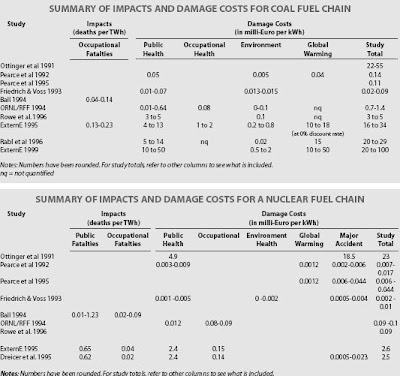
Also, look at the statistical difference in impact when looking at coal power and nuclear power side by side.


Why do we need to pick on nuclear power so much?

Friday, January 22, 2010

An Obscenely Bad Idea

Normally I try to keep my views on politics that are not related to nuclear energy and other technological and scientific developments off of this blog, because I feel that N^4 is not the place for that sort of thing. However, I feel I must speak up about the most recent ruling by the US Supreme Court regarding campaign contributions by corporate interest groups. In effect, it has ruled that there is no cap or limit in terms of how much a company can spend on an election campaign to influence its outcome. The amount of corporate influence in our country's major elections is already intolerable, and now this practically a validation that the voices of corporations are more important than the rest of the voting public. As it is, many of our political "representatives" are already bought and paid for as they effectively do the bidding of who ever has the deepest pockets. In this case, it is almost like the equivalent of applying a thick layer of grease to the highway to hell as we are all forced to ride it through its inevitable downward spiral.

I have had some doubts that our political system was up to the task of looking after the welfare of our nation's citizens, but this ruling has made its inherent dysfunction blatantly obvious. Prior to this ruling, I have also kept my views on healthcare off of this blog because I felt it was a subject that was best left untouched as my blog is not normally meant to be a political soapbox. However, I have been following the whole debate with a feeling of rising anger as I saw how people that were elected to represent us were fully prepared to deliver us bound-and-gagged to the very corporate racketeering scheme that people were seeking shelter from. Needless to say, my confidence in my government has largely taken a complete nosedive after my trust in it had already been languishing for years.

The implications of this ruling are obvious. It takes the first amendment and places it for sale to the highest bidder as it says that free speech can now be bought and sold like any other commodity. Those with limited financial means are now considered to be "less free" as they would not be able to afford to purchase as much "freedom" unlike some of our well-heeled corporate representatives. Our political system is broken, and evidently beyond repair at this point as it has largely resisted any attempt at reform.

So, once again I apologize to my readers for the brief outburst of indignation but this has made me very angry indeed. It does not matter whether you consider yourself a conservative or a liberal at this point your right to free speech has been given a price sticker. Unless you can afford to buy up all of the media outlets, thinktanks, and funnel soft money to political candidates, your first amendment rights have now largely been revoked. We might as well dress up in our new company-issued uniforms complete with a ball gag and handcuffs and bow before our corporate overlords. Our Supreme Court has failed us all.

Tuesday, January 19, 2010

Changing Minds, but is it Enough?

When I started this blog two years ago, it was out of a combination of frustration and anger at how quickly people dismissed nuclear energy like it was some sort of arcane and unholy type of technology. Even though the facts were otherwise, many people still opposed it tooth and nail as they either ignored the benefits or thought that the data itself was part of some sort of conspiracy promoted by "Big Nuclear". I was never against nuclear power at all, even when I was relatively misinformed about it but I did have some reservations about what to do with the spent fuel as I like many other people thought that it was dangerous and difficult to deal with. However, I still thought that was magnitudes better when compared to coal and natural gas. As these fuel sources were very dirty indeed and as it was the late 20th, early 21st century I thought that it was ridiculous that we were still depending on fossil fuels as our main source of energy. Yet I also knew that wind and solar power lacked the energy density and reliability to be able to produce the amount of electricity on a regular basis that a developed country like the US needed.

Then my eyes caught an article in Scientific American around 2005 talking about nuclear energy and what sorts of reactors could be built and the pros and cons of the different designs. I was fascinated as I read about designs that could be used to breed more fuel or greatly reduce the quantity and half-life of existing stockpiles of spent fuel as well as close the nuclear fuel cycle to ensure a virtually infinite and environmentally friendly source of energy. I also began to grow very angry, as the only thing holding nuclear technology back seemed to be a combination of NIMBYism, fossil fuel interests, and just the overall lack of will that would be needed to restructure our energy producing infrastructure.

I began to research nuclear power online as a hobby in addition to reading whatever I could find on it in various books and publications. My amazement was underlined by seething anger at how the US had let coal and natural gas expand and entrench themselves over the decades as we had not built a new nuclear reactor in this country since the 1970s. Our back was turned on nuclear power out of a combination of fear, pointless bureaucratic redtape, and the canceling of many planned reactor projects after the oil crisis thirty-seven years ago. This was all due to politics and scaremongering rather than a legitimate reason to condemn nuclear power.

This was a direct reversal of the attitude that characterized the previous two decades as nuclear powerplants were being built at a rapid pace and nuclear reactors were quickly adapted to be used for naval use. The cold war and a feeling of optimism towards nuclear science and technology spurred rapid development in this field and it also threatened to put coal power out of business. However, the nuclear industry was practically moribund by the early eighties through a misinformed but successful campaign against nuclear energy that had grown out of the fear of nuclear warfare and was helped along by fossil fuel lobbyists and their paid off politicians. Ironically, nuclear power has had the best safety record of any energy sector in the US and even across the world yet it had been rejected in favor of coal which kills thousands of people worldwide through its normal operation.

After seeing the ridiculous comments and hysterical fears surrounding nuclear power being touted by various "environmentalists" I decided to create this blog in the hopes of taking an honest look at nuclear power. This was part of an effort to help people realize the environmental benefits of an infrastructure largely based on nuclear energy as well as the fact that nuclear power is the only clean form of energy that can be used practically anywhere on earth and deliver a constant supply of energy regardless of weather conditions. Scaling back production and energy usage would never be the answer because as we increase our technological development, the demand for energy increases. However, it is through more technology, not less that we can hope to make a better world for everyone. The past is gone, but trying to revisit the past by rejecting technological progress would be foolish because the "past" presented by various primitivist and neoluddite groups is based on a highly idealized and impractical vision of what previous generations of humanity really faced. Ironically, the popularity of these movements has been aided by the technology brought to them by the internet and computer revolution. I would very much doubt that humanity would want to go back to the days before running water, electricity, heating, cooling, hygiene, sanitation, and modern medicine. We can thank all of these previous comforts for our greatly improved lifespans. A few hundred years earlier, a middle-aged man or woman of 40 would be considered elderly.

As I look around, I see that people are slowly starting to realize that nuclear energy is not nearly as bad as various sources portray it as being. There is a lot of misinformation and outright lies regarding nuclear technology as there are many organizations that have made it their business to vehemently oppose nuclear power on all fronts, especially when they have or are allied with entrenched fossil fuel interests. I have a cautious degree of optimism as I watch people starting to push back against this tide of nonsense and hope that we can start looking forwards to a clean, energy rich future again as nuclear power is the only option that we have that can deliver on this promise. We need to get the liquid fluoride thorium reactor development path up and running again after its cancellation during the early 1970's as this design shows a stunning degree of versatility and efficiency at practically little to no cost to the environment.

Tuesday, December 22, 2009

Odds and Ends

I have added the informative blog, BraveNewClimate to my blog roll as it has been recommended to posters on the Energy From Thorium forum. The blogger, Barry Brooks does an excellent job in reporting on developments in climate science as well as critically examining the potential feasibility of "green" energy sources such as "renewables". Take a look at his December 17th post on the potential of the LFTR in Australia.

In other news, Florida might be making the shift from coal power to nuclear energy as Seminole Electric canceled its latest plan for a coal power station. As Seminole Electric has also been considering nuclear power as one of its future energy options, this might be a point in favor of nuclear power. Florida is relatively poor in natural gas, and transporting natural gas over long distances is an expensive undertaking.

Saturday, December 5, 2009

Christianity and Politics

At the risk of drifting too far into politics, I would like to comment on the phenomenon of Christian conservatives who have aligned themselves with the Republican party in the American political system. Does the current day Republican party turn many atheist would be supporters away because of its emphasis on religiously motivated social conservatism?

I have watched the documentary "Gay Republicans" with interest as it showed the conflict that arose between homosexual Republicans and the apparent ideology of the current day Republican party. Do Republican atheists feel a similar disenfranchisement with the American GOP? Is this enough to prevent them from voting for or supporting the Republican party during elections?

Speaking from my own experience, I disagree with the Democratic party on many things. However it seems as if the base of the Republican party is formed from Christian fundamentalists, (Often militant ones at that) Young Earth Creationists, theocratically motivated authoritarians, as well as an underlying feeling of homophobia. GOP might as well stand for God's Own Party. However, this could just be personal bias on my part since it seems like you only hear about the trouble makers.

For the atheists that are reading this blog, how much does the religious wing of the modern Republican party affect your viewpoint of the party as a whole? Does it discourage or frighten you? Are atheist Republicans and conservatives a diminishing minority in our political system as a result? Your feedback would be greatly appreciated.

Friday, November 27, 2009

Atomic Insights Stomps on Silliness

As Rod Adams on the Atomic Insights blog points out, existing nuclear power plants are extremely well run and highly efficient facilities. Their equipment and components are routinely checked and updated as they have to be in order to provide a steady output of power during their operation.

This is why when people like Christian Parenti portray nuclear power plants as being decrepit structures harking from the Cold War era, it is a grossly inaccurate portrayal. A nuclear power station is an extremely durable structure that is built to last. The containment dome is an extremely thick shell of reinforced concrete that can withstand that ravages of time, weather, and the occasional aircraft impact. The reactor itself is operated by highly trained and competent technicians who make sure that everything is operating smoothly. The strong culture of safety behind the nuclear industry speaks for itself, because the accident of Three Mile Island did not result in any deaths or injuries despite there being a core meltdown.

The fact of the matter is, that this sort of fear mongering about nuclear energy is never warranted, and causes people to panic needlessly. The paranoia of nuclear power is what is giving coal and natural gas their business as we see more fossil fuel burners being built to meet increasing energy demand. The nuclear genie is already out of the bottle, so we might as well put it to use.

Monday, July 27, 2009

Replacing Fossil Fuels by Using More Natural Gas?

One thing that I do not understand is why natural gas is being pushed so much by "environmentalists", particularly because natural gas does produce quite a bit of carbon dioxide when burned. Not as much as coal, mind you, but enough to be a major contributor of carbon dioxide pollution. Renewable energy sources such as wind and solar are hardly efficient and are basically a roundabout way of burning natural gas as natural gas burning generators have to take up the slack when the wind is not blowing or the sun is not shining. There are also vehicles that run on liquified natural gas as opposed to gasoline. If we look at the annual estimated end use statistics for natural gas since 1949, you will see that consumption has risen greatly*.

Consumption Graph

Also, looking at this graph, you can see that the annual wellhead price for natural gas has risen sharply to meet demand since the year 2000*.

Price Graph

Natural gas is as much as a fossil fuel as coal and oil yet much of the renewables paradigm is leading to a rapid increase in natural gas consumption both on the atmosphere as well as depletion of consumers wallets. Because of the rapid fluctuations in price that natural gas is subject to, this increasingly expensive fuel energy source is an impractical alternative for running an energy grid. It will also make coal cheaper by comparison and lead to increased usage of coal in the long run as natural gas prices continue to climb at a much faster rate than coal prices.

To make a long story short, natural gas is a fossil fuel and like all fossil fuels has major disadvantages. The renewables movement only increases our reliance on fossil fuels in the form of natural gas and coal while derailing interest and funding from viable sources of energy such as nuclear power. I do not mean to come off as being harsh in regards to solar and wind power, but the only practical application that either of these two energy sources seem to have is for the operation of small appliances or for pumping water.

*As provided by the US Energy Information Administration.

Sunday, July 26, 2009

Those Krazy Katholics Are At It Again

In case you thought that all of the sexual abuse scandals involving the Catholic church were over and done with, we have another round of cover-ups by a Bishop who wanted to hide the misdeeds of the priests in his parish. Refresh my memory, but how many "moral authority" by default cards does a religious organization get before it is considered a degenerate cult? After all of this, I would SERIOUSLY think twice about letting my child be an altar boy if I were a parent and a Catholic one at that.

Oh, and religion turning a blind eye towards sexual abuse is not strictly confined to the Catholics...just look at what self-proclaimed Christian prophet Tony Alamo was doing. The transportation of grossly underage girls across state lines for sexual purposes is hardly befitting for a man who claims holiness in his actions.

Here we see him claiming that this is some sort of government conspiracy against him as well as "Jesus" by extension...


Tony Alamo is found guilty on all ten charges...


Suffer the little children indeed.

Friday, May 15, 2009

Whither the Nuclear Renaissance?

I have heard mixed opinions from the Obama administration in regards to nuclear energy. Energy secretary Steven Chu seems to have a cautiously positive opinion of nuclear power. At the same time it seems the stimulus bill passed in February had the loan guarantees for nuclear construction written out of it while spending billions of dollars on "renewables" even though renewable energy sources by their very nature are both expensive and unreliable. I am left wondering what Obama really plans to do about nuclear power.

He at least acknowledged it during his campaign but when he said in needed to be "safer" it made me think that he was uninformed about how safe nuclear power really is. Very few industries in the world have safety records that could compare to nuclear energy in terms of the lack deaths or injuries in the years since nuclear energy was first developed. The two infamous incidents, Chernobyl and Three Mile Island are frequently referenced by wide-eyed activists but the Chernobyl reactor did not have a containment dome that could have prevented the entire disaster as all new reactors across the world have now. At Three Mile Island, human error and lack of maintenance combined lead to a very serious malfunction, yet the safety systems built into the design of Three Mile Island prevented anybody from being injured or killed by the incident. To drive the point home even further, I have never heard of a single incident of somebody being injured or killed by spent fuel. Yet despite all of this, an embarrassingly large segment of the world population is eager to listen when activists paint the nuclear industry as being a modern day "Frankenstein's monster" poisoning the land and the nearby people with a mysterious force called radiation. Much of the public's imagination (Often fueled by science fiction B movies) has taken to thinking of radiation as being something that causes spontaneous and severe mutations such as animals growing to several hundred times their normal size or sprouting extra limbs. The more "informed" merely think that a nuclear power plant by its very nature will somehow cause the nearby populace to fall ill and be struck down by maladies such as cancer and radiation sickness.

Also, on the face of it, the idea seems rather absurd as to why Steven Chu seems unwilling to consider the MSR designs for Gen IV funding because of proliferation fears. The proliferation risk of an MSR design is quite low because the entire reactor would have to be shut down in order to divert the produced U233 into weapons production. The U233 will be contaminated with U232 and U234 that decay producing hard gamma radiation and terrorists working in a hastily constructed garage or cave would be hard pressed to steal enough for a bomb without instantly dying of radiation poisoning. There is also the question about how a terrorist would manage to steal liquid U233 from the molten core of the MSR which is surrounded by a massive field of radiation especially since you would have to shut down the MSR and reroute the plumbing of the reactor for such an operation. With that being said and done, it would be a lot easier to raid a radiology clinic for nuclear material.

Finally, the appointment of Gregory Jaczko as the new Chairman of the NRC has me concerned. Part of the problem of constructing new nuclear facilities is the inefficient and often nonsensical approval process that a power company must go through in order to obtain an operating license. I have heard some reports that Jaczko is in agreement with some anti-nuclear environmentalists groups and that he voted against renewing the operating license for the Oyster Creek reactor in New Jersey as well as collaborating with Rep. Ed Markey (D) for imposing more stringent regulations on classifying spent fuel when the nuclear industry is already choking on overregulation in general.

This is not to say that previous presidential administrations have been any more open minded in regards to promoting nuclear energy. The Bush administration amidst many of its other problems paid lip service to nuclear power while simply allowing it to languish during its pursuit of fossil fuel energy in the form of coal, oil, and natural gas. In fact, a large part of presidential candidate McCain's energy policy during his campaign was the promotion of "clean coal" of which there is no such thing. Opposition to nuclear power sadly seems to be a bi-partisan phenomenon in the US.

Perhaps I am being overly pessimistic here. I would like to get a discussion going as to what my readers think we might expect in regards to nuclear energy under this administration. Are nuclear energy promotion efforts really being noticed, or are they just a minority in the void of the internet that is too willing to pat itself on the back as coal and natural gas take center stage in the future as they have in the past?

Sunday, January 18, 2009

Biology is in BIG Trouble

Creationists are causing a nuisance again. This time, they managed to get the Louisiana Science Education Act passed. This forces the Louisiana Board of Elementary and Secondary Education to let instructors teach whatever nonsense the instructors want to teach in place of established scientific theories. In other words, you can bet that this will be the perfect opportunity for intelligent design and other disguised forms of creationism to rear their ugly heads in the public classroom again. As if to drive the point home even further, the book Explore Evolution, by the Discovery Institute (A well-known creationist organization) is expected to be selected as the biology book of choice all across Louisiana. Shame on you, Bobby Jindahl!

Texas is about to fuck itself over as well. The Texas Board of Education spends massive amounts of money on textbooks every year. If the nutty creationists who sit on the Texas Board of Education get their way, this will have a negative influence on the entire biology textbook industry geared towards high school and grade school. This is because publishing companies will start producing more books that espouse intelligent design and other creationist nonsense in order to appeal to their main customers.

To all Louisianians and Texans reading this post, I suggest you go to your state government and public education representatives NOW and RAISE HELL! The future of science depends on you. Creationists are trying to dismantle science in an agenda to impose their narrow-minded ideology on the entire country.

Do not give up without a fight! The Texas Board of Education votes on this matter next week! The details can be read here on the Bad Astronomy blog.

Thursday, December 25, 2008

It Is Christmas Once Again

I would just like to take the time to wish my readers a nice Christmas and hope that they got all that they asked for on their lists. I also hope that they get plenty of good food to eat and that their guests do not become too much of a burden. Finally, while you are making sure that everybody is having a wonderful time, do not forget to enjoy yourselves as well.

Although I am an atheist, I celebrate Christmas because the true meaning of Christmas which is happiness and celebration during the dreariness of winter is something that we could all appreciate. All of the religious trappings such as the legend of the birth of Jesus and Solstice celebrations are merely window dressing obscuring what is important, which is to have a good time. Christmas was never originally a Christian holiday because the idea had been stolen lock stock and barrel from the Roman holiday of Saturnalia as well as borrowing extensively from the Yule celebrations of the Germanic tribes. The legend surrounding the birth of Jesus Christ was added much later by early Christians as part of an adaptation of the pagan holiday.

This could be said to be similar how the tradition of Halloween was adapted and eventually secularized from the Celtic tradition of Samhain. Few people who go out trick or treating know the cultural origins of Halloween and how it originally became established. I know that some people have started branding Halloween as a pagan holiday as of late and are therefore refusing to celebrate it, but if that is the case, than Christmas is guilty of that offense as well.

In fact, during the Cromwell rebellion of Great Britain during the 1600's; the celebration of Christmas was banned by Cromwell because he correctly thought that it was pagan by nature and wanted to set a good example for the Puritans to follow. Needless to say, Christmas was immediately reinstated with the reestablishment of the British monarchy during the reign of Charles II.

So keep in mind that the tradition of Christmas is as pagan as holidays come. To all of those people who are saying that non-Christians are ruining the holiday, step back and consider who's holiday it was to begin with. Very few things including religious ideas are truly original, as they are merely adaptations of the things that came before them in history. Merry Christmas, everybody!

Wednesday, December 24, 2008

Merry Christmas From Old King Coal

It looks like the citizens of Harrington, Tennessee have been naughty this year. A coal slurry retaining wall has broken, contaminating four hundred acres worth of property with coal ash and demolishing fifteen homes in the process. That is more than enough coal for anybody's stocking, no matter how bad they have been.


The aging Tennessee Valley Authority site has been damaged as a result of the heavy rains that have been hitting the area in recent weather patterns. This has caused the retaining wall of the coal slurry reservoir to break and overflow. Clean up is going to be an extensive process lasting several years, possibly enough to warrant classifying the area as a Superfund site.

The reason why this is such a disaster is that coal slurry is vile stuff. Coal slurry is coal ash that has been mixed with water to make the particulate matter less apt to blow away and contaminate the quality of the air. Coal slurry contains numerous heavy metals such as lead, mercury, cadmium, arsenic to name just a few hazardous substances. The irony is that problems like this go largely unnoticed by media sources while the same agencies go into hysterics about the isolated issues of some nuclear power plants.

Let this be a lesson to the people who are against nuclear power of what reliance on coal power actually means. Disasters like this are by no means uncommon in the coal industry because by nature coal power is a dirty business. The sooner we switch to nuclear power the sooner that events like this will become a thing of the past. King Coal rules his kingdom with a sooty fist and all of us are suffering from his oppression.

Friday, December 19, 2008

Rick Warren? Give Me A Break!

I guess Obama decided to once again curry favor with the Religious Right by picking a staunch fundamentalist to give his Inauguration Day speech. Rick Warren is openly against atheists, homosexuals, and is a Young Earth Creationist to boot. Why do slimeballs like this always get into power?

I hope that we will not have to put up with leftwing theocrats during the Obama presidency like we have had to stomach rightwing theocrats during Republican rule. America was NOT founded on religious principles, but a clearly stated separation of church and state. By choosing people like Warren to represent our political leadership, we are dragging ourselves to the bad old days of that 'ol time religion of intolerance and bigotry. Is this what we really want?

Friday, November 14, 2008

Elizabeth Dole's Campaign Actually Backfired

It is doubtful that this was the only reason that Dole lost against Hagan but it does show that it making slurs against atheists in public is no longer being considered acceptable in some social spheres. Within a very short time of Dole airing her infamous ad, her political opponent soon began getting several thousand campaign contributions during a campaign fundraiser in Boston. These contributors were composed of not only disgruntled atheists, but also religious people who thought that Dole's ad was highly offensive and inappropriate even for a campaign ad.

Historically, in public polls atheists are regarded as being the least popular minority by the general populace in regards to being fit for political office. This is why "under God" was added during the Pledge of Allegiance during the red scare in order to distinguish Americans from the "godless" Soviet Union. I am glad to see that people are beginning to challenge the negative perception that atheists have in the US and I hope that atheism will no longer be regarded as a dirty word by many people.